
Property Management Automation Case Study – Real Estate
Overview
This client manages a sizable portfolio of rental units and needed a better way to handle tenant inquiries, maintenance requests and lease renewals without everything running through one shared inbox.
Nexa Solutions Hub built a complete automation system to separate and manage each of these request types individually, so nothing got lost in a single generic queue.
Before this project, prospective tenants, current tenants and lease renewal conversations were all landing in the same place, which made it genuinely difficult to prioritize what actually needed attention first.
The Challenge
Prospective tenant inquiries, maintenance requests and lease renewal conversations were all mixed together, with no way to tell them apart without opening and reading each message individually.
Maintenance issues sometimes sat unanswered for days at a time, not because the team didn’t care, but because there was no system flagging urgency or tracking how long a request had been open.
Lease renewals were only caught when someone happened to notice a date approaching on a spreadsheet, which meant renewals occasionally slipped past their window entirely, creating unnecessary stress for both the team and the tenant.
Our Objectives
Going into this project, the priority was separating these three very different types of requests and giving the team a system that could flag urgency and track progress automatically. These goals shaped everything we built.
- Separate tenant inquiries, maintenance requests and lease renewals into distinct workflows
- Automate the first response for every maintenance request
- Build a lease renewal reminder sequence tied to each unit’s actual end date
- Give the property team a clear pipeline for every open request
Strategy
We began by separating the three types of requests the client actually deals with day to day, since a prospective tenant, a current tenant reporting a leaking faucet, and a lease renewal all needed a completely different path through the system.
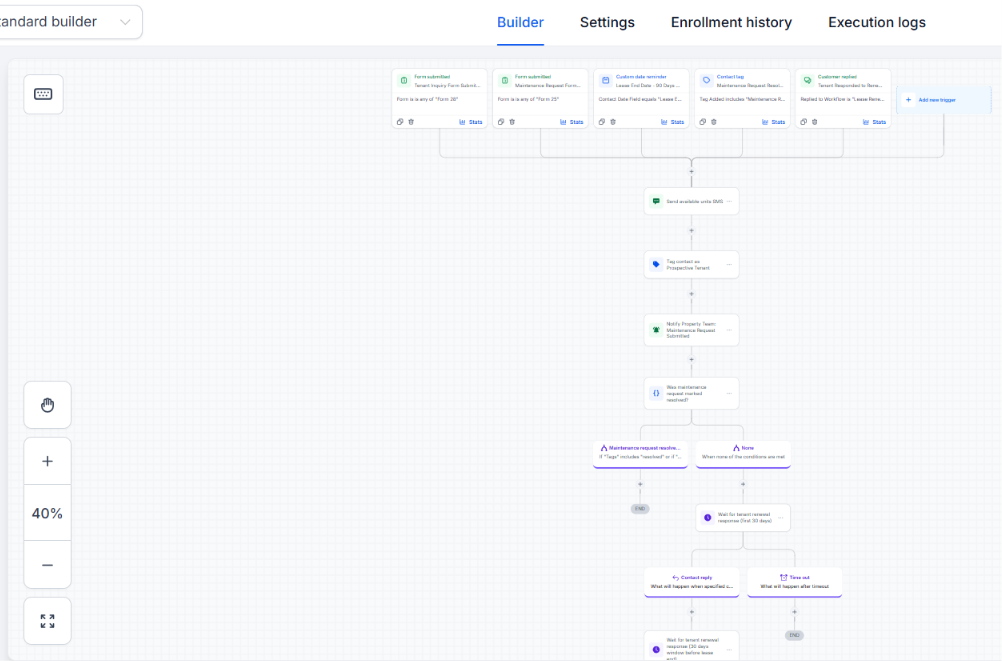
Three separate forms were built, one for each request type, so submissions arrived already tagged and sorted instead of landing in one generic inbox for someone to manually sort through later.
Prospective tenant inquiries triggered an automated response with available unit information and a scheduling link, so interested renters could book a viewing without waiting on a callback.
Maintenance requests triggered an immediate acknowledgment confirming the request had been received, along with an estimated response window, so tenants weren’t left wondering if their message had actually gone through.
Each maintenance request was routed into a dedicated pipeline with stages from reported through to resolved, giving the property team an actual queue to work from instead of a pile of unread messages.
For lease renewals, we built a workflow tied to each unit’s real lease end date, automatically reaching out to the tenant at ninety, sixty and thirty days out with renewal terms and a simple way to respond.
Renewals that went unanswered close to the deadline triggered an internal alert to the property team, so nothing expired without someone actually being aware it was coming up.
We tested every workflow against real scenarios, including a maintenance request submitted late at night and a renewal date that landed on a weekend, to make sure timing held up no matter when something actually came in.
Conclusions
This project is a good example of how property management, while technically part of real estate, comes with its own set of ongoing needs that a standard buyer and seller funnel just isn’t built to handle.
Separating these request types made an immediate difference in how quickly maintenance issues got addressed and how consistently renewals were caught before their deadline passed.
For us, this case highlights how important it is to actually understand the day to day operations of a business before building automation around it, rather than applying a generic real estate template to something that needed its own structure.
Solutions and Results
Once the system was live, the client had a way to separate and prioritize every type of tenant interaction instead of relying on one shared inbox and hoping nothing important got buried.
- Three dedicated workflows built for inquiries, maintenance and renewals
- An automated first response live for every maintenance request
- Lease renewal reminders tied to each unit’s actual end date
- A working pipeline giving the property team visibility into every open request
Do you want to Transform your brand into a future powerhouse? It’s time to kick things off.